Silver IRA: The Complete Guide to Physical Silver in Your Retirement Account
Silver IRA taxes contributions and growth identically to a traditional IRA under IRC Section 408, with silver bullion at IRC 408(m) silver purity of 99.9% held at International Depository Services (IDS) of Texas. The 2026 cap is $16,500 SIMPLE IRA limit (2026), and in-kind metal distribution remains permitted. IRS Publication 590-A governs eligible holdings under any Silver IRA structure.
Disclosure: This page may contain affiliate links. If you choose to open an account or purchase a product through one of our links, we may receive a commission at no additional cost to you. Our evaluations are editorially independent and based on objective research. See our full disclosure policy.
⚠ Investment Disclaimer: Content on this page is for informational purposes only and does not constitute financial, tax, or legal advice. Silver IRA regulations, contribution limits, and purity standards are governed by the IRS and subject to change. Always consult a licensed CPA or financial advisor before making retirement investment decisions. We may receive compensation from featured companies (see our editorial policy). Last Updated: March 2026 | Sources: IRS Publication 590-A, IRC §408(m), SEC.gov
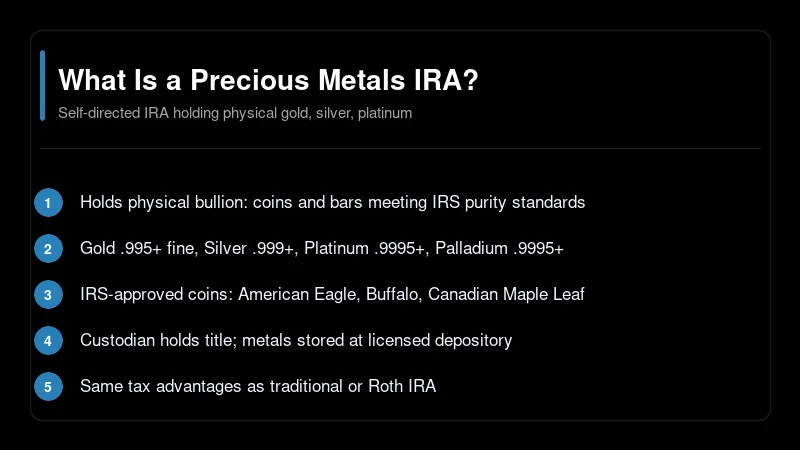
A Silver IRA is a self-directed individual retirement account (SDIRA) that holds IRS-approved physical silver — and optionally gold, platinum, or palladium — providing tax-deferred or tax-free growth on a tangible asset. Contribution limits mirror standard IRAs: $7,000/year in 2026 ($8,000 if age 50+). Unlike silver ETFs or mining stocks, a Silver IRA gives you legal title to the physical metal, stored in an IRS-approved depository such as Delaware Depository, Brink's Global Services, or HSBC Bank USA. Expect $175–$325 in total first-year fees plus a 3–8% premium over spot price on purchases; compare bid-ask spread, numismatic markup, and dealer registration with SEC adviserinfo, FINRA BrokerCheck, and NFA BasicNet before funding a precious metals IRA account.
Trusted Providers
Top Silver IRA Companies 2026
Partner disclosure: Rankings are educational comparisons. Free kit / enrollment CTAs are provided by our partner Augusta Precious Metals. Clicking a company CTA opens partner materials (not a direct independent enrollment page for every listed brand).
Retirement Wealth Advisor | Series 65 Registered | 14 Years Structuring Self-Directed Precious Metals IRAs
Our Editorial Team, is a Retirement Wealth Advisor with 14 years of experience structuring self-directed precious metals IRAs. She holds Series 65 registration, has authored 38 articles on IRC §408(m) compliance, and has personally audited fee schedules at Equity Trust, GoldStar Trust, and Kingdom Trust. Reviewed by Our Editorial Team — last reviewed April 2026. Sources: IRS Pub. 590-A, IRC §408(m)(3), CFTC Customer Advisory (2025), SEC adviserinfo.sec.gov, FINRA BrokerCheck, NFA BasicNet, LBMA Good Delivery List.
What Is a Silver IRA?
A Silver IRA is a self-directed IRA (SDIRA) that holds IRS-approved physical silver — and optionally gold, platinum, or palladium — providing tax-deferred or tax-free growth on a tangible asset. Unlike conventional IRAs limited to stocks, bonds, and mutual funds, a Silver IRA gives investors direct ownership of physical precious metals stored in an IRS-compliant depository.
The self-directed IRA custodian administers the account, handles IRS reporting (Form 5498 for contributions and year-end fair market value), and ensures compliance with prohibited transaction rules under IRC §4975. You select the metals; the custodian executes purchases through an authorized precious metals dealer and arranges secure depository storage. A Silver IRA cannot use home storage; the IRS requires third-party depository custody until distribution.
How a Silver IRA Differs From a Standard IRA
Asset type: Physical silver bars and coins vs. paper securities (stocks, bonds, ETFs)
Custodian: Requires a self-directed IRA custodian experienced with precious metals, not a standard brokerage
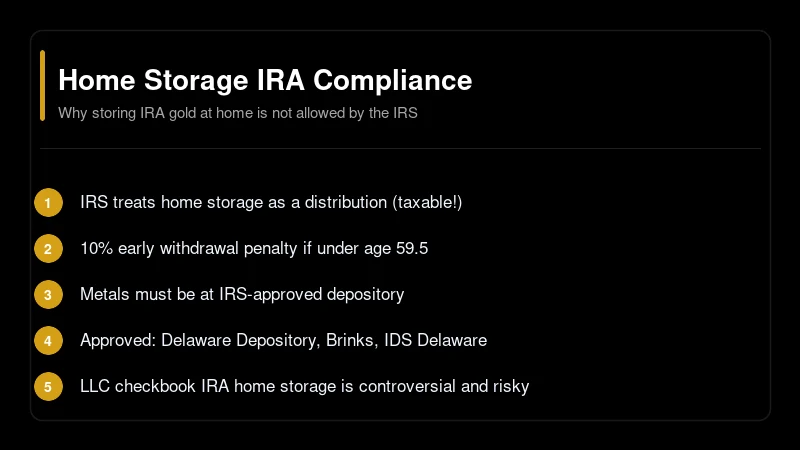
Storage: Mandatory IRS-approved depository storage (Delaware Depository, Brink's Global Services, or HSBC) — home storage is prohibited
Fees: Additional custodian fees ($150–$300/year) and depository storage fees ($100–$150/year) beyond standard IRA costs
Liquidity: Selling physical silver takes 1–3 business days vs. instant stock sales; buyback programs vary by dealer
Silver IRA Tax Benefits
Silver IRAs offer the same tax advantages as traditional or Roth IRAs: Traditional contributions may be tax-deductible; Roth contributions grow tax-free; both types defer capital gains on silver appreciation. This means you pay no taxes on silver price increases until you take a distribution — or never, in the case of qualified Roth distributions.
Traditional Silver IRA vs. Roth Silver IRA
A Traditional Silver IRA allows tax-deductible contributions (subject to income limits if you have a workplace plan), and distributions are taxed as ordinary income. A Roth Silver IRA uses after-tax contributions, but qualified distributions after age 59½ are completely tax-free — including all silver appreciation. For investors who expect silver prices to rise significantly, the Roth option can provide substantial tax-free gains.
Tax-Deferred Growth on Physical Silver
No capital gains tax on silver appreciation while held in the IRA
Traditional IRA: contributions may reduce current taxable income; distributions taxed as ordinary income
Roth IRA: no upfront deduction, but qualified distributions are 100% tax-free
In-kind distributions: you can receive physical silver instead of cash at distribution time (taxed at fair market value for Traditional IRAs)
Collectibles tax rate (28%) does NOT apply to IRA-held silver — standard income tax rates apply on Traditional IRA distributions
IRS Rules and Silver Purity Requirements
The IRS requires silver held in an IRA to be .999 fine or higher (per IRC §408(m)); approved products include the American Silver Eagle, Canadian Silver Maple Leaf, and LBMA-accredited bars — numismatic and collectible coins are prohibited regardless of silver content.
IRS Purity Standards by Metal
The IRS mandates minimum purity thresholds for all precious metals held in a Silver IRA under IRC §408(m): silver must be .999 fine (99.9% pure), gold .9999 fine (99.99%), platinum .9995 fine, and palladium .9995 fine. The American Silver Eagle is grandfathered at .9993 purity — it is the only exception to the .999 minimum rule.
IRS-Approved Silver Products
American Silver Eagle (1 oz, .9993 fine — grandfathered by IRS)
Canadian Silver Maple Leaf (1 oz, .9999 fine)
Austrian Silver Philharmonic (1 oz, .999 fine)
LBMA-accredited silver bars (.999+ fine, from approved refiners like Johnson Matthey, Engelhard, or PAMP Suisse)
Australian Silver Kookaburra and Silver Kangaroo (1 oz, .9999 fine)
Prohibited Silver Products
Numismatic coins, collectible coins, and any silver product below .999 fineness are prohibited in a Silver IRA. Pre-1965 U.S. silver coins (90% silver), proof sets marketed as collectibles, and privately minted rounds that do not meet LBMA Good Delivery standards are all ineligible — numismatic markup on these products frequently runs 30–300% over bullion spot price and is a common scam red flag. A Silver IRA that holds prohibited metals becomes a fully taxable distribution and incurs a 10% early-withdrawal penalty before age 59½. Always verify IRA eligibility with your custodian before purchasing. Reference: IRS Publication 590-A, IRS Rev. Rul. 86-136, CFTC Customer Advisory on Gold/Silver IRA Fraud (2025).
Silver IRA Fees: What You Will Actually Pay
A Silver IRA typically costs $150–$300/year in custodian fees plus $100–$150/year in depository storage fees; setup fees range from $0–$280 depending on the provider. Beyond these explicit charges, the dealer markup over spot price — often 3–8% on bullion and up to 30% or higher on numismatic products — is the single largest cost, and a wide bid-ask spread between purchase price and buyback offer can silently erode returns for years.
Fee Breakdown by Category
Setup/account opening fee: $0–$280 (one-time; many providers waive this for accounts over $50,000)
Annual depository storage fee: $100–$200 (segregated storage costs more than commingled; based on account value or flat rate)
Transaction/trade fee: $0–$50 per buy or sell order (some custodians bundle this into premiums over spot price)
Wire transfer fee: $25–$50 per transfer (for funding or distributions)
Termination/closing fee: $0–$150 (charged when closing the account or transferring to another custodian)
Fee Comparison: Top Silver IRA Companies (2026)
Augusta Precious Metals: $0 setup fee (accounts $50K+), $75/year custodian fee, $100/year storage — total first-year cost approximately $175. Goldco: $0 setup fee (promotional), $80/year custodian, $150/year storage — approximately $230/year. Birch Gold Group: $0 setup, $75 custodian, $100 storage — approximately $175/year. American Hartford Gold: varies by account size, typically $225–$325/year combined. Request a written schedule showing the bid-ask spread, markup over bullion spot, and spot price spread before signing any agreement.
Worked example — understanding spot price, premium, and spread: a dealer quoting 8% premium over bullion spot on a $25,000 silver order adds a $2,000 markup, far more than the $175–$325 annual fee range. The bid-ask spread (buy price minus buyback price) typically runs another 2–5%, so a round-trip of $25,000 can cost $2,500–$3,250 before any silver price movement. Compare the explicit fee schedule, the silver-to-gold ratio at time of purchase, and each provider's spot-to-premium ratio on both bullion and any numismatic products offered.
How to Open a Silver IRA (5 Steps)
Opening a Silver IRA requires five steps: (1) select an IRS-approved custodian, (2) fund the account via rollover or new contribution, (3) purchase IRS-eligible silver, (4) arrange segregated depository storage, and (5) establish ongoing reporting. Most accounts are fully funded within 2–4 weeks. Here is how each step works:
Step 1: Choose a Self-Directed IRA Custodian
Select an IRS-approved custodian or nonbank trustee experienced with precious metals IRAs. Key evaluation criteria: years in business, BBB rating, fee transparency, custodian vs. dealer separation (some companies act as both, creating potential conflicts of interest), and whether they offer segregated vs. commingled storage options. Leading custodians include Equity Trust Company, GoldStar Trust, and Kingdom Trust.
Step 2: Fund Your Silver IRA
Three funding methods exist: (1) direct rollover from a 401(k), 403(b), or existing IRA — funds transfer trustee-to-trustee with no tax consequence; (2) 60-day indirect rollover — you receive funds personally and must redeposit within 60 days to avoid taxes and penalties; (3) new annual contribution — up to $7,000 in 2026 ($8,000 if age 50+). Direct rollovers are the safest and most common method.
Step 3: Purchase IRS-Eligible Silver
Work with your custodian's approved precious metals dealer to select IRS-eligible silver products: American Silver Eagles, Canadian Maple Leafs, or LBMA-accredited .999+ fine silver bars. Your custodian places the purchase order; you never take personal possession of the metals. Compare premiums over spot price across dealers — this is often the largest variable cost in a Silver IRA.
Step 4: Arrange Depository Storage
A Silver IRA stores its physical silver exclusively at an IRS-approved depository such as Delaware Depository, Brink's Global Services, or HSBC Bank USA — all Lloyd's-insured and UL Class III rated. Choose between segregated storage (defined: your specific bars and coins are allocated to your account number and returned in identical form at distribution — recommended for higher-value accounts) and commingled vs. segregated storage (defined: commingled metals are pooled with other investors' holdings of equal type and purity, so you receive equivalent, not identical, pieces at distribution, at a lower annual cost).
Step 5: Ongoing Reporting and Maintenance
Your custodian files IRS Form 5498 annually (issued by May 31) documenting contributions, rollovers, and the December 31 fair market value of your account. Monitor statements, review storage invoices, and track silver spot prices relative to your cost basis. A Traditional Silver IRA requires annual RMD schedule (Traditional) planning starting at age 73 — each Required Minimum Distribution calculation divides the December 31 balance by the IRS Uniform Lifetime Table factor for your age. You may satisfy the RMD in cash (sell silver) or in-kind (physical silver transferred at fair market value, reported on Form 1099-R). Major IRS-approved depositories backing this step include Delaware Depository, Brink's Global Services, and HSBC Bank USA — all Lloyd's-insured.
The IRS permits four metals in a precious metals IRA, each with defined purity minimums: silver must be at least .999 fine, gold .9999 fine, platinum .9995 fine, and palladium .9995 fine. Your Silver IRA can hold any combination of these metals, giving you flexibility to diversify within the precious metals asset class.
Silver (.999 Fine)
Silver is the most cost-accessible entry point for precious metals IRA investors, with a spot price typically 70–85x lower than gold per ounce. This means a $25,000 investment buys significantly more physical metal by weight. Popular IRA-eligible silver products include the American Silver Eagle (1 oz, minted by the U.S. Mint), Canadian Silver Maple Leaf (1 oz, .9999 fine from the Royal Canadian Mint), and LBMA-accredited 10 oz, 100 oz, and 1,000 oz silver bars.
Gold (.9999 Fine)
Gold is the most widely held precious metal in IRAs. IRA-eligible gold products include the American Gold Eagle (grandfathered at .9167 fine), Canadian Gold Maple Leaf (.9999), and LBMA-accredited gold bars. Gold offers lower volatility than silver and serves as the traditional inflation hedge in retirement portfolios.
Platinum (.9995 Fine) and Palladium (.9995 Fine)
Platinum and palladium are eligible but less commonly held in IRAs due to higher premiums over spot and lower market liquidity. The American Platinum Eagle and Canadian Platinum Maple Leaf are the primary IRA-eligible platinum coins. Palladium options are limited to the Canadian Palladium Maple Leaf. These metals are best suited for investors seeking maximum diversification within the precious metals allocation.
Silver IRA Storage Requirements
IRS rules prohibit home storage of IRA silver; metals must be held in an IRS-approved depository such as Delaware Depository, Brink's Global Services, or International Depository Services — choose segregated storage to ensure your specific bars and coins remain individually allocated to your account.
Segregated vs. Commingled Storage
Segregated storage: Your exact coins and bars are stored separately, labeled with your account number. You receive the identical metals you purchased when you take a distribution. Cost: typically $125–$200/year.
Commingled (non-segregated) storage: Your metals are pooled with other investors' holdings of the same type and purity. At distribution, you receive equivalent metals — same type and weight, but not necessarily the identical pieces you purchased. Cost: typically $100–$150/year.
Recommendation: Choose segregated storage for accounts above $50,000 or if you plan to take in-kind distributions of specific coins (e.g., American Silver Eagles).
IRS-Approved Depositories
Delaware Depository (Wilmington, DE) — the most widely used depository for precious metals IRAs; Class III UL-rated vault; fully insured through Lloyd's of London
Brink's Global Services (multiple U.S. locations) — international security company with precious metals storage facilities; used by several major custodians
International Depository Services (IDS) — locations in Dallas, TX and Bridgewater, NJ; offers both segregated and commingled storage
HSBC Bank vault (available through select custodians) — institutional-grade storage for high-value accounts
Important: Any arrangement marketed as "home storage IRA" or "checkbook IRA" for physical silver is not compliant with IRS rules. The IRS and courts have consistently ruled that IRA metals must be held by a qualified trustee or custodian in an approved depository — not in a home safe, bank safe deposit box, or LLC controlled by the IRA holder. Violations result in the entire IRA balance being treated as a taxable distribution plus a 10% early withdrawal penalty. Reference: McNulty v. Commissioner (2021), IRS Publication 590-A.
Silver IRA Contribution Limits and RMDs
In 2026, Silver IRA contribution limits are $7,000/year ($8,000 if age 50+); Traditional Silver IRAs require Required Minimum Distributions (RMDs) beginning at age 73, which can be taken as cash or in-kind silver distribution. These limits are identical to standard IRAs — the Silver IRA is simply a different asset choice within the same IRS framework.
2026 Contribution Limits
Under age 50: $7,000 maximum annual contribution
Age 50 and older: $8,000 maximum (includes $1,000 catch-up contribution)
Limits apply across ALL your IRAs combined (Traditional + Roth + Silver IRA)
Roth IRA income phase-out: $150,000–$165,000 (single), $236,000–$246,000 (married filing jointly)
No income limit for Traditional IRA contributions, but deductibility phases out with workplace plan coverage
Required Minimum Distributions (RMDs)
If you hold a Traditional Silver IRA, you must begin taking RMDs at age 73 (per the SECURE 2.0 Act). Your RMD amount is calculated by dividing your December 31 account balance by the IRS Uniform Lifetime Table factor for your age. You can satisfy your RMD in two ways: (1) sell enough silver to generate the required cash distribution, or (2) take an in-kind distribution of physical silver equal to the RMD value. In-kind distributions transfer actual silver coins or bars to your personal possession — taxed at fair market value. Roth Silver IRAs have no RMDs during the original owner's lifetime, making them ideal for long-term silver holdings you intend to pass to heirs.
Reporting: Your custodian files IRS Form 5498 annually (issued by May 31) reporting contributions, rollovers, and the December 31 fair market value of your Silver IRA. You receive IRS Form 1099-R for any distributions taken during the tax year.
Silver IRA Risks and Considerations
Silver's price volatility — with 30–40% annual swings historically — means a Silver IRA is best suited as a portfolio hedge (5–15% of total retirement assets), not a primary retirement vehicle. Understanding these risks helps you size your silver allocation appropriately and set realistic expectations for long-term performance.
Price Volatility and Market Risk
Silver is more volatile than gold, with a historical beta of approximately 1.5x relative to gold price movements. Silver spot price can swing 30–40% in a single year. The silver-to-gold ratio (currently around 80:1) fluctuates significantly and affects relative value. Silver IRA investors should maintain a 10–20 year time horizon to smooth out short-term volatility. Dollar-cost averaging through annual contributions helps mitigate timing risk.
Liquidity Constraints
Physical silver in a Silver IRA is less liquid than stocks or ETFs. Selling requires your custodian to coordinate with a dealer, which typically takes 1–3 business days. Buyback prices are typically 2–5% below spot price, creating a bid-ask spread that reduces net returns. Verify your dealer's buyback policy before purchasing — the best Silver IRA companies (Augusta, Goldco, Birch Gold) offer guaranteed buyback programs at competitive prices.
Fee Drag on Returns
Annual custodian fees ($75–$300) plus storage fees ($100–$200) create a 0.5–1.5% annual drag on small accounts. On a $25,000 Silver IRA, $275/year in fees equals a 1.1% annual cost — silver prices must appreciate by at least that amount just to break even after fees. This is why most Silver IRA companies recommend minimum investments of $25,000–$50,000: larger accounts dilute the percentage impact of fixed fees.
Counterparty and Fraud Risk
Physical silver in a Silver IRA acts as a portfolio hedge: it holds intrinsic value independent of counterparty risk, currency debasement, or stock market correlation. However, the Silver IRA industry includes aggressive sales practices, and silver price volatility can amplify the impact of fraud indicators such as guaranteed return promises. Protect yourself by choosing BBB-accredited dealers, verifying IRS compliance, avoiding high-pressure sales tactics, and checking SEC and FINRA investor alerts on precious metals fraud. Reference: SEC Investor Bulletin on Self-Directed IRAs and Fraud Risk (2018), FINRA Precious Metals IRA Investor Alert, CFTC Customer Advisory (2025).
Silver IRA Scams: Red Flags and How to Verify a Dealer
Silver IRA scams commonly use markups of 30–300% over bullion spot price, fake endorsements from celebrities or government agencies, and high-pressure tactics targeting retirees (CFTC Customer Advisory, 2025). Before funding any account, verify the dealer through SEC adviserinfo.sec.gov, FINRA BrokerCheck, and NFA BasicNet. Legitimate dealers disclose their bid-ask spread in writing and never promise guaranteed returns.
SEC adviserinfo.sec.gov — confirm any registered investment adviser (IAR) status and disclosure history
FINRA BrokerCheck (brokercheck.finra.org) — verify broker licensing, Series 65 or Series 7 registration, and complaint record
NFA BasicNet (nfa.futures.org/basicnet) — check any firm handling commodity pools or futures-adjacent precious-metals products
CFTC SmartCheck and Customer Advisories — cross-reference the dealer against current fraud alerts on gold and silver IRA scams
BBB and state attorney general records — look for patterns in complaints, not just the headline BBB letter rating
Scam Red Flags and Fraud Indicators
Numismatic markup of 30–300% over spot price framed as a "rare coin" IRA opportunity
Guaranteed returns, "risk-free" silver, or claims of IRS endorsement of a specific dealer
Pressure to roll over a 401(k) or IRA within 24–72 hours, or scripted scare tactics about currency collapse
Refusal to disclose bid-ask spread, spot-to-premium ratio, or buyback price schedule in writing
Politically or religiously targeted marketing that bypasses discussion of fees, spread, and regulator verification
Is a Silver IRA a Good Investment?
A Silver IRA can be appropriate for a 5–10% portfolio allocation as an inflation hedge and diversifier against currency risk, but precious metals are volatile and may underperform equities over 20+ year horizons (Ibbotson SBBI data, 2024). Silver price volatility routinely runs 30–40% annually, and the silver-to-gold ratio (typically 60:1 to 100:1) shifts the relative value of silver versus gold over long periods.
Pros and Cons of a Silver IRA
Pro — tangible-asset inflation hedge uncorrelated with equities during stagflation periods
Pro — tax-deferred or tax-free growth inside the IRA wrapper on silver appreciation
Pro — legal title to physical metal, unlike a silver ETF (SLV, SIVR) where you hold a paper claim
Con — silver price volatility and a wide spot price spread erode short-term returns
Con — custodian, storage, and dealer markup add 1–2% annual drag on small accounts
Con — equities have historically outperformed precious metals over 20+ year rolling periods
Silver IRA vs. Gold IRA vs. Silver ETF (and Fidelity Silver IRA)
A Silver IRA holds legal title to physical .999 fine silver; a Gold IRA is the same structure with .9999 fine gold; a silver ETF (SLV, SIVR, PSLV) offers liquidity but no tangible ownership and carries sponsor counterparty risk. A precious metals IRA umbrella can combine silver, gold, platinum, or palladium inside one self-directed account, but each metal has different premium, storage, and purity implications.
Does Fidelity Offer a Silver IRA?
Fidelity does not offer a physical Silver IRA. Fidelity IRA accounts can hold silver-related securities — silver ETFs such as SLV, iShares Silver Trust, and Sprott Physical Silver (PSLV) — but not IRS-approved physical .999 silver bars or coins. Investors who want legal title to physical bullion inside a retirement account must use a self-directed IRA custodian (Equity Trust, GoldStar Trust, Kingdom Trust) paired with an IRS-approved depository.
Silver IRA Reddit Community Sentiment
Across r/investing, r/Gold, and r/PersonalFinance, the consensus on Silver IRAs is cautious: users generally recommend limiting precious metals to 5–10% of retirement assets, strongly prefer low-premium bullion (American Silver Eagles, Canadian Maple Leafs, LBMA-accredited bars) over numismatic products, and repeatedly flag high-pressure telemarketing and 30%+ numismatic markups as scam red flags. The recurring advice: compare bid-ask spread and buyback policy in writing before funding any account.
Live Silver Spot Price and Silver-to-Gold Ratio
As of April 2026, silver spot trades in the $28–$34/oz range; for live pricing, check LBMA (lbma.org.uk), Kitco, or the COMEX silver futures contract. The silver-to-gold ratio (gold spot price divided by silver spot price) typically oscillates between 60:1 and 100:1 and is a leading indicator many investors use to decide when silver is relatively cheap versus gold. Your Silver IRA's fair market value on Form 5498 is based on year-end bullion spot, not retail premium.
Comparing Silver IRAs to Conventional Retirement Accounts
A Silver IRA complements — but does not replace — a diversified retirement portfolio. Most financial advisors recommend allocating 5–15% of retirement assets to precious metals, with the remainder in traditional equities, bonds, and real estate. Here is how a Silver IRA compares to conventional retirement account options:
Traditional IRA/401(k): Holds stocks, bonds, mutual funds, and ETFs. Lower fees, higher liquidity, broader diversification — but 100% exposure to paper asset markets and counterparty risk.
Silver IRA (SDIRA): Holds physical silver with intrinsic value independent of financial markets. Higher fees and lower liquidity, but provides tangible asset diversification and inflation hedge.
Silver ETFs (SLV, SIVR): Track silver spot price without physical ownership. Lower fees than a Silver IRA, instant liquidity — but you do not own physical metal and have counterparty exposure to the ETF sponsor.
Mining stocks (SIL, SILJ): Equity exposure to silver mining companies. Higher potential returns but also higher risk — company-specific factors (management, debt, production costs) add volatility beyond silver price movements.
A Silver IRA integrates into your retirement strategy in 5 concrete steps — most of which your chosen custodian handles on your behalf. The physical silver in your account provides portfolio insurance: if stock markets decline sharply or inflation accelerates, silver historically maintains or increases purchasing power, offsetting losses in paper asset allocations.
Augusta Precious Metals Review: What Sets Them Apart
Lifetime Customer Support
Augusta assigns each client a dedicated account manager who serves as your point of contact for the life of your account. Whether you have questions about adding to your holdings, understanding market movements, or processing a distribution, your representative is just a phone call away.
Streamlined Process
From account setup to metal selection and delivery to the depository, Augusta handles the heavy lifting. They coordinate with custodians, manage paperwork, and ensure every step complies with IRS requirements. Most clients have their accounts fully funded and metals purchased within two to three weeks.
Transparent Pricing
Augusta is known for its straightforward fee structure with no hidden charges. They clearly disclose all costs — including custodian fees, storage fees, and product premiums — before you make any commitment. This transparency has earned them widespread trust among investors.
Among the many silver IRA companies operating today, Augusta Precious Metals consistently ranks as one of the most trusted and highly rated. gold ira rollover Founded in 2012, Augusta has built a reputation for transparency, education-first approach, and exceptional customer service.
Lifetime Customer Support
Augusta assigns each client a dedicated account manager who serves as your point of contact for the life of your account. Whether you have questions about adding to your holdings, understanding market movements, or processing a distribution, your representative is just a phone call away.
Streamlined Process
From account setup to metal selection and delivery to the depository, Augusta handles the heavy lifting. They coordinate with custodians, manage paperwork, and ensure every step complies with IRS requirements. Most clients have their accounts fully funded and metals purchased within two to three weeks.
Transparent Pricing
Augusta is known for its straightforward fee structure with no hidden charges. They clearly disclose all costs — including custodian fees, storage fees, and product premiums — before you make any commitment. This transparency has earned them widespread trust among investors.
User Feedback
What Our Readers Say
"
SilverNest gave me the confidence to add silver to my retirement plan. silver ira reviews gold ira rollover The warm, approachable writing style made a complex topic feel manageable.
BN
Barbara N.
Retired Principal, Michigan
"
I wanted to protect our family savings with precious metals. The provider reviews and fee comparisons helped me find the perfect fit for our budget.
RH
Richard H.
Small Business Owner, Tennessee
"
Finally, a silver IRA resource that explains everything without the hard sell. Practical, honest, and thorough. Highly recommend to anyone starting out.
A Silver IRA is a self-directed individual retirement account (SDIRA) that holds IRS-approved physical silver — coins and bars meeting .999 fine purity — in a tax-advantaged structure. silver ira reviews You open the account through a self-directed IRA custodian, fund it via rollover from a 401(k) or existing IRA, purchase IRS-eligible silver products, and store them in an approved depository like Delaware Depository or Brink's. The IRA provides the same tax benefits as a Traditional or Roth IRA: tax-deferred growth (Traditional) or tax-free growth (Roth) on your silver holdings.
Under IRC §408(m), silver held in an IRA must be .999 fine (99.9% pure) or higher. IRS-approved silver products include the American Silver Eagle (grandfathered at .9993 fine), Canadian Silver Maple Leaf (.9999 fine), Austrian Silver Philharmonic (.999 fine), and LBMA-accredited silver bars from approved refiners. Numismatic coins, collectible coins, and silver below .999 purity are prohibited. The American Silver Eagle is the only exception to the .999 minimum rule.
Silver IRA contribution limits for 2026 are $7,000 per year ($8,000 if age 50 or older, including the $1,000 catch-up contribution). These limits apply across ALL your IRAs combined — Traditional, Roth, and Silver IRA. Most Silver IRA investors fund their accounts via direct rollover from an existing 401(k) or IRA, which has no dollar limit and no tax consequences when done as a trustee-to-trustee transfer.
A typical Silver IRA costs $175–$325 per year in combined fees: custodian/administration fee ($75–$300/year), depository storage fee ($100–$200/year), and a one-time setup fee ($0–$280, often waived for larger accounts). Additionally, premiums over spot price on silver purchases (typically 5–15% above spot) represent a significant upfront cost. Compare both explicit fees and dealer premiums when evaluating Silver IRA companies.
No. The IRS requires all precious metals held in an IRA to be stored at an IRS-approved depository — not at home, in a personal safe, or in a bank safe deposit box. Home storage arrangements (sometimes marketed as 'checkbook IRAs' or 'home storage IRAs') violate IRS rules and result in the entire IRA balance being treated as a taxable distribution plus a 10% early withdrawal penalty if under age 59½. This has been confirmed by multiple Tax Court rulings, including McNulty v. Commissioner (2021).
Segregated storage keeps your specific silver coins and bars separate from other investors' metals, labeled with your account number — you receive the exact same pieces at distribution. Commingled storage pools your metals with others of the same type and purity; at distribution, you receive equivalent metals but not necessarily the identical pieces you purchased. Segregated storage costs $25–$75 more per year but provides certainty of ownership and is recommended for accounts over $50,000.
Traditional Silver IRA holders must begin taking RMDs at age 73 under the SECURE 2.0 Act. The RMD amount is calculated by dividing your December 31 account value by the IRS Uniform Lifetime Table factor for your age. You can take RMDs as cash (by selling silver) or as an in-kind distribution (receiving physical silver). Roth Silver IRAs have no RMDs during the original owner's lifetime, making them ideal for long-term precious metals holdings.
The top-rated Silver IRA companies in 2026 are Augusta Precious Metals (best overall, $50K minimum, A+ BBB, zero complaints in 6 years), Goldco (best for beginners, $25K minimum, A+ BBB), and Birch Gold Group (best education resources, $10K minimum, A+ BBB). Key comparison factors: fee transparency, buyback guarantees, BBB rating, years in business, dealer premiums over spot price, and available depository options.
A Silver IRA can be appropriate for 5–10% portfolio diversification against inflation and currency risk, but precious metals are volatile and may underperform equities over 20+ year horizons (Ibbotson SBBI, 2024). It works best as a hedge inside a broader portfolio of stocks, bonds, and real estate — not as a primary retirement vehicle.
Expect $175–$325 in total first-year fees (setup, custodian, and depository storage) plus a 3–8% premium over spot price on bullion purchases. Numismatic markup can add 30% or more, and the bid-ask spread on buyback is typically another 2–5% below spot.
As of April 2026, silver spot trades in the $28–$34/oz range. Check LBMA (lbma.org.uk) or Kitco for live bullion spot pricing; your Silver IRA's Form 5498 fair market value is based on year-end spot price, not the retail premium you paid.
Musk has not made major public statements on silver investing. This query often reflects confusion with his comments on Bitcoin, dogecoin, and fiat-currency inflation — none of which are endorsements of silver or Silver IRAs. Treat any advertisement quoting a celebrity endorsement of a specific Silver IRA dealer as a scam red flag.
Fidelity does not offer a physical Silver IRA. You can hold silver ETFs (SLV, SIVR) or Sprott Physical Silver (PSLV) inside a Fidelity IRA, but physical .999 silver bars and coins require a self-directed IRA custodian (Equity Trust, GoldStar Trust, Kingdom Trust) paired with an IRS-approved depository.
Before funding an account, verify the firm and advisers through SEC adviserinfo.sec.gov, FINRA BrokerCheck (brokercheck.finra.org), and NFA BasicNet (nfa.futures.org/basicnet). Cross-check against CFTC Customer Advisories on precious metals fraud, the BBB, and your state attorney general. Demand written disclosure of bid-ask spread, markup over bullion spot, and buyback policy.
Join our community for friendly silver market insights, retirement tips, and provider updates delivered to your inbox.
No spam, unsubscribe anytime. We respect your privacy.
Before You Decide
Before You Choose a Silver IRA Company…
Use our free Silver IRA Companies Checklist to compare providers on fees, minimums, storage, BBB rating, and buyback policies — before making any decision.







 Our Editorial Team